In February, more than 100 students from 11 Kane County high schools spent a day at Elgin Community College telling adults the truth. They talked about anxiety, stress, and being worn out. Several tied the rise in missed school days to emotional exhaustion. They said that when a student is absent because of anxiety or depression, a detention makes it worse. What they asked for was simple: an adult at school who knows them and listens.
I believe them. I have heard the same thing from students for most of my career.
What I learned as a principal. I was principal of Westmont Junior High for nine years. In 2017 we partnered with Hope For The Day, a Chicago nonprofit focused on proactive suicide prevention and mental health education. We wrote a three-year plan together and worked it. Every staff member received mental health training before students arrived in August 2018. Social-emotional lessons ran in our advisory classes. Parents came in at night for sessions on raising a resilient teen and on screens and social media. We took steps toward becoming a trauma-informed school.
Students and staff organized a Self-Expression Fest with Hope For The Day, and it came back for a second year. The idea was simple. Every student picked the thing that helps them get through a hard day and showed it off: karate, singing, sports, baking, playing an instrument, video games, a walk in the woods, volunteering. That is resilience. It is not a poster on the wall. It is a kid knowing what steadies them and reaching for it before the bad day turns into a bad week.
The DuPage region of the Illinois Principals Association recognized our school and Hope For The Day together with its Reaching Out and Building Bridges Award. In September 2019 I co-chaired Hope For The Day’s Conversation Summit at the UIC Forum, where my students and I led a session on how serving others builds resilience. I later served as a strategic advisor to the Hope For Us Network, which continues that prevention work.
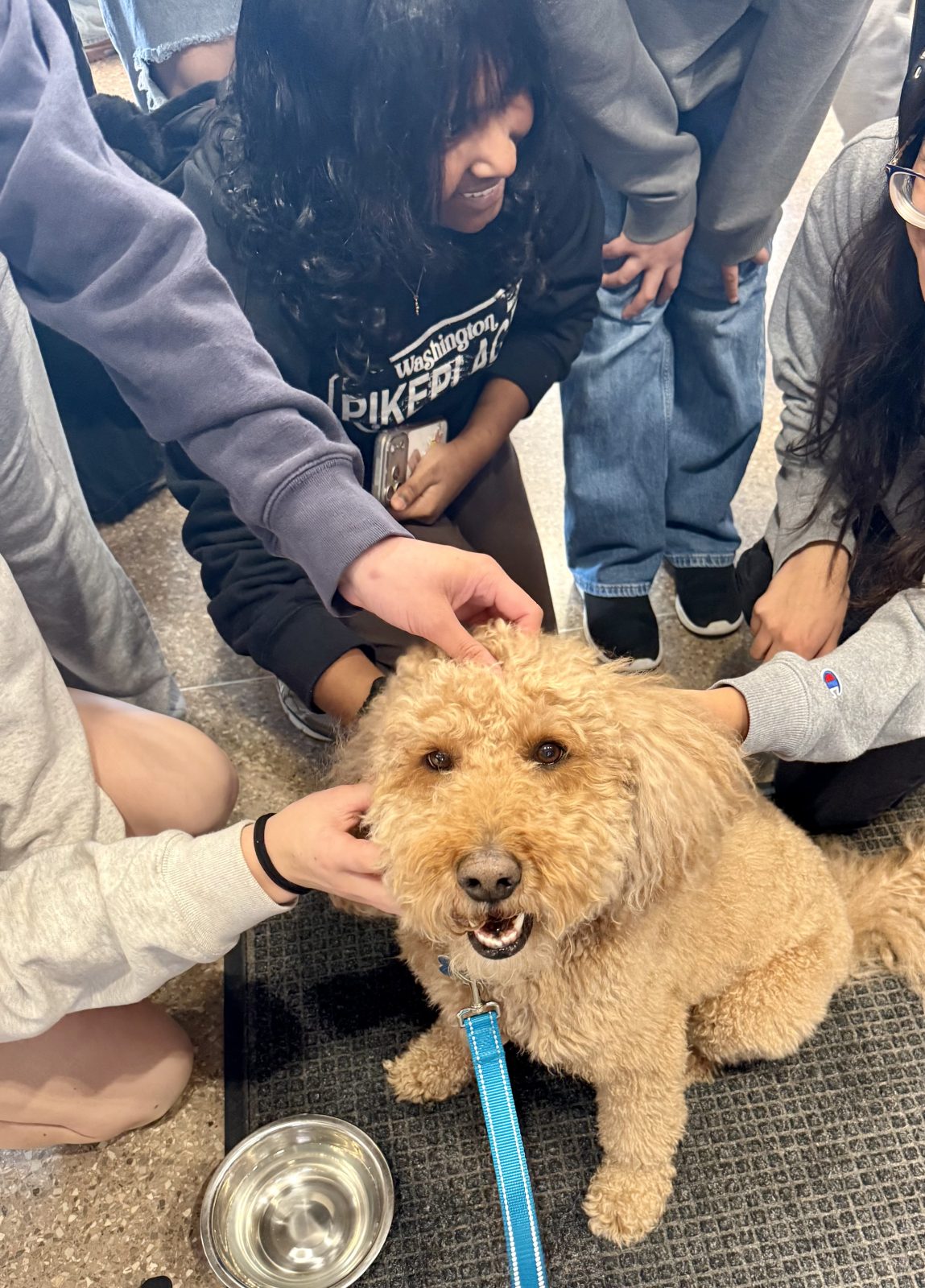
Then there is Emmy. In 2018 I brought a proposal to the Westmont school board for an educational assistance dog. We chose a Goldendoodle to keep allergies down, gave families an opt-out form, and started her training. Emmy became part of the school day. She still comes with me to Kane County schools. Sometimes the job is just to notice a kid who is having a hard day, and sit with them.
Some of this I learned by living it. I learned about carrying loss as a platoon sergeant in Afghanistan. I learned it again as a father, when we lost our oldest daughter, Katie, in 2016. My school community showed up for my family. I have not forgotten what that meant.
What the Regional Office of Education does now. The day at Elgin Community College was the seventh annual Youth Voices Forum on Mental Health. The Kane County Health Department hosts it in partnership with the ROE. Nineteen youth-serving organizations set up tables so students could see what help exists outside their school.
Our Youth Outreach team handles truancy for the county. They work on-site in schools and start with why a student is missing, whether that is transportation, mental health, a change at home, or trouble in class. That is what the students at the forum asked adults to do.
The ROE also received state SEL Hub funding. That means any Kane County school can get free help from us: a review of its mental health and school climate practices, staff training on trauma-informed classrooms and student belonging, and coaching to put a plan into practice. We offer sessions on staff well-being and preventing burnout too. A worn-out teacher has a hard time being the trusted adult a student needs.
The people doing this work every day. The students at the forum said their school social workers and counselors are knowledgeable and helpful. They also said there are not enough of them. Both things are true, and the people in those jobs across our nine districts are carrying a lot. In Batavia, social workers teach a wellness curriculum in the early grades and run small groups for students who need more. St. Charles built a set of tools so a family can find a counselor who takes their insurance without calling ten offices. In Aurora, both districts opened their buildings to a counseling agency this year so students can see a clinician during the school day instead of waiting weeks for an appointment across town. In District 300, a high school trained the student facilitators who led the small groups at the forum. A district social worker or counselor sees more of what kids carry than almost anyone, and the ROE’s job is to make their work easier, not to add to it.
None of this works alone. We are part of the Kane County System of Care for children’s mental health, led by the Health Department. We sit on the advisory council of the Kane County Circle of Care, launched in January with CASA Kane County, DCFS, and more than a dozen other partners. Last fall we brought school counselors, psychologists, and social workers together with a circuit judge, the State’s Attorney’s office, and public defenders to talk about students involved with the courts. Our alternative programs served 209 students last year, and we run the school inside the Juvenile Justice Center. Many of those students are carrying more than any kid should.
What comes next. The students gave us a list. Connect every student to a trusted adult. Respond to attendance problems with support before punishment. Train more staff. Help parents know where to turn. The ROE does not run your child’s school. What we can do is make sure nine districts are not solving the same problem nine separate times.
If you or a young person you know is struggling, call or text 988 any time, day or night. It is OK not to be OK.
John K. Jonak
Every student. Every community. Every day.
WHERE TO TURN
- In a crisis: call or text 988, the Suicide and Crisis Lifeline. For youth in Illinois, the CARES line is 800-345-9094.
- Families: Kane County children’s mental health resources from the Health Department.
- Hear from students: 2026 Youth Voices Forum on Mental Health report.
- Schools: free SEL and mental health support from the ROE.
- Attendance concerns: how our Youth Outreach team works with families.