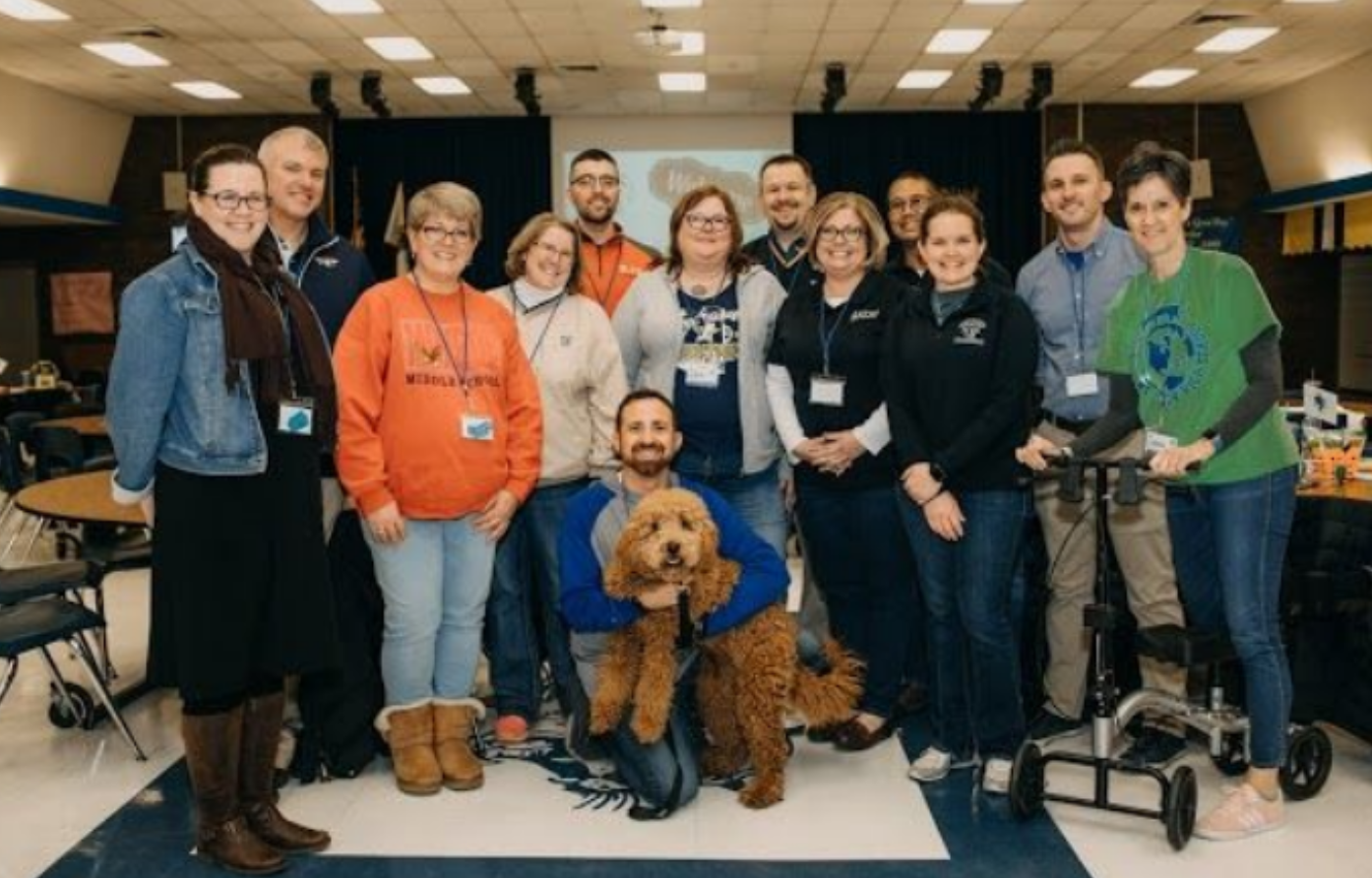
In 2019, while I was principal of Westmont Junior High School and working on my Ed.S. at Northern Illinois University, I wrote a paper titled Striving for 51%. The title came from something every principal knows: we are supposed to spend at least half of our day as instructional leaders, and most of us don't. The paper asked a harder question, though. If the research says teacher collaboration builds teacher confidence, and teacher confidence built together is one of the strongest predictors of student learning we have, what was I doing, day to day, to build it?
Seven years later, I'm still asking that question. Only now I get to ask it on behalf of nine school districts, 161 public schools, and more than 9,600 educators in Kane County.
What the research actually says
The idea starts with psychologist Albert Bandura. He described self-efficacy as a person's belief that they can organize and carry out what it takes to reach a goal, and he found that those beliefs shape how hard people try, how long they persist, and how they handle setbacks. Bandura also found that a strong sense of efficacy among teachers could outweigh the drag of poverty on student achievement.
Researchers later took that idea from the individual to the group. Collective teacher efficacy is the shared belief among the teachers in a school that, together, they can make a real difference for their students. In 2011, Rachel Eells, in a dissertation at Loyola University Chicago, pooled 26 studies and found a strong, consistent relationship between collective teacher efficacy and student achievement across every subject measured.
John Hattie brought that finding to the front of the conversation. In his Visible Learning research, which synthesizes well over a thousand meta-analyses, collective teacher efficacy came in at an effect size of 1.57, which is roughly four times the average influence on student learning. Hattie's current database (updated February 2026) now draws on three meta-analyses and 85 studies and puts the figure at 1.34. The number has come down as more research has come in, and it should be read as a strong relationship rather than a guarantee. It is still near the very top of everything Hattie has measured.
What I have always appreciated is how Hattie describes it. Collective efficacy is not cheerleading or a poster in the staff lounge. It is teachers working together to set high, challenging expectations for a year's growth, and then feeding that belief with evidence that their work is producing it. In his words, it is the conviction that "it is us that causes learning." Not the students' zip codes. Not the barriers outside the building. Us.
Newer research sharpens that point in three useful ways:
- Belief alone isn't the lever. A 2025 meta-analysis of 71 studies found that an individual teacher's self-confidence has only a small relationship with student performance on its own. The power shows up when belief is shared, tested against evidence, and built into how a staff works together.
- Leadership shapes it. A 2024 analysis of 26 studies and nearly 20,000 educators found that a principal's instructional leadership is strongly tied to collective efficacy, and that collective efficacy in turn helps explain teachers' own sense of confidence. What leaders do (or don't do) matters.
- It protects teachers, too. A 2025 review of 49 studies found that stronger collective efficacy is linked to fewer negative outcomes for teachers themselves, like burnout. At a time when we are working hard to keep good teachers in classrooms, that matters.
What I learned building it
I didn't learn this from a journal first. I learned it in buildings.
Professional learning communities at Westmont. Beginning in 2012, CUSD 201 released students an hour early every Wednesday so teachers could meet in PLCs. That commitment of time was a gift, but time by itself wasn't enough. Our teams worked through the four questions made famous by Rick DuFour and his colleagues: What do we want students to learn? How will we know they learned it? What will we do if they don't? What will we do if they already know it?
When I wrote Striving for 51%, I was honest about where we fell short. In a small school where one teacher often covered an entire grade level in a subject, some teams felt isolated. Looking at data had drifted toward compliance instead of changing what happened in classrooms the next day. So we changed the structure: we stacked PLC and department time into a full two-hour block, put an instructional coach or administrator in every department meeting, and asked teams to anchor their work to clear, non-negotiable priorities. As a retired Soldier, I recognized what we were building. It was the Army's After Action Review applied to teaching: what did we plan, what happened, why, and what will we do differently tomorrow?
Westmont went on to be named a national School to Watch in 2019, one of about 400 middle schools in the country recognized as high-performing and developmentally responsive to young adolescents. During my time there, the school moved from around the 33rd percentile to the top 15 percent of Illinois middle schools. They are now ranked in the top 10%. I credit the teachers and leaders. They did the work, and they came to believe their work was the reason it was working.
A principal network that crossed district lines. In 2015, I started a small Local Principal PLN with middle school principals from around DuPage County. The idea was simple: meet quarterly, rotate host schools, tour each other's buildings, and bring our real problems to the table. Over the years, we met at schools like Cass Junior High, Mannheim Middle School, Westchester Middle School, Rotolo Middle School, Butler Junior High, and Westmont Junior High. That group later grew into the DuPage Principal Collaborative, which I was proud to hand off to Dr. Jacob Buck of Eisenhower Junior High when I moved into a district role.
In fall 2018, we expanded the network to teachers. Each principal brought two or three teachers from a single subject, and math, science, social studies, and literacy teachers from different districts spent a morning or afternoon learning from one another. When we asked for feedback, every science teacher who responded said it was a valuable use of their time. One math teacher wrote that they loved having time with teachers from other districts to discuss and bounce ideas off each other. That is collective efficacy growing in real time. We presented at the Illinois Principal Association's Conference on this work.
EdCamp: educators teaching educators. That same network organized In the Middle: DuPage Area EdCamp at Westmont Junior High in March 2018 and again on March 1, 2019. EdCamps flip the traditional conference model. There is no preset agenda; participants pitch session topics on sticky notes that morning, and the day is built around what the people in the room want to learn and are ready to share. In 2019, roughly 160 to 175 middle-level educators joined us, free of charge, supported by local businesses, districts, and community partners who donated everything from lunch to classroom supplies. When teachers see a colleague from another district solve the same problem they are wrestling with, they start to believe they can solve it too.
What Kane County does now
When I arrived at the Kane County Regional Office of Education, I found a team already living this work. Here is what professional learning looks like across Kane County today:
- Monthly professional learning networks for superintendents, HR directors, business officials, finance directors, instructional coaches, student services leaders, safety leaders, learning leaders, and more, with most or all of our nine districts represented.
- More than 1,450 educators took part in ROE workshops and academies in fiscal year 2025.
- Instructional coaching that partners with teachers and teams to co-plan, model, observe, and give feedback, with an explicit goal of strengthening PLCs and collective efficacy. This fall alone, our coaches led workshops in East Aurora D131 and West Aurora D129.
- New Principal Mentoring that pairs first- and second-year principals and assistant principals with experienced mentors, because the research is clear that school leaders shape the conditions for collective efficacy.
- Continuous school improvement support as an ISBE-approved Learning Partner, helping schools build systems for data analysis, progress monitoring, and leadership coaching.
- Branching Out, a weekly video series of short, practical classroom strategies from our professional learning team.
- Kane County Institute Day on Friday, February 26, 2027, at the Q Center in St. Charles, alongside the Arts Ed Institute. Our call for presenters is open through November 2, because the best professional learning in Kane County often comes from Kane County educators.
- AI policy training for district leadership teams, funded through a $22,706 grant, so districts can plan for new technology together rather than alone.
What this asks of all of us
If collective efficacy is one of the strongest levers we have, then professional learning can't be a series of one-time events. It has to be how we work. A few lessons I carry from Westmont to Geneva:
- Protect the time, then protect what happens in it. A schedule creates opportunity. Clear questions and real student work create results.
- Leaders belong in the room. Principals and district leaders who learn alongside their teachers send a message no memo can.
- Feed belief with evidence. Celebrate growth when you see it, and show teachers the proof that their decisions caused it.
- Let teachers teach teachers. Some of the most powerful learning I've witnessed came from a colleague down the road, not an expert from out of state.
- Look beyond your walls. Networks across schools and districts break isolation, especially in small schools and singleton roles.
When I think back on Striving for 51%, I realize the goal was never really about how a principal spends the clock. It was about building places where teachers believe, and can see, that what they do together changes students' lives. That is the work. Every student. Every community. Every day.
John K. Jonak
Every student. Every community. Every day.
References
- Bandura, A. (1997). Self-efficacy: The exercise of control. W.H. Freeman.
- DuFour, R., DuFour, R., Eaker, R., & Many, T. (2010). Learning by doing: A handbook for professional learning communities at work. Solution Tree.
- Eells, R. J. (2011). Meta-analysis of the relationship between collective teacher efficacy and student achievement (Doctoral dissertation, Loyola University Chicago). https://ecommons.luc.edu/luc_diss/133/
- Goddard, R., Goddard, Y., Kim, E. S., & Miller, R. (2015). A theoretical and empirical analysis of the roles of instructional leadership, teacher collaboration, and collective efficacy beliefs in support of student learning. American Journal of Education, 121(4), 501–530.
- Hattie, J. (2023). Visible learning: The sequel. Routledge.
- Karakose, T., Kardas, A., Kanadlı, S., Tülübaş, T., & Yildirim, B. (2024). How collective efficacy mediates the association between principal instructional leadership and teacher self-efficacy. Behavioral Sciences, 14(2), 85. https://doi.org/10.3390/bs14020085
- Ma, K., Cavanagh, M., Zhang, J., & Chutiyami, M. (2025). The association between teacher self-efficacy and student academic performance: A systematic review and meta-analysis. Educational Research Review, 48, 100701. https://doi.org/10.1016/j.edurev.2025.100701
- Sahli Lozano, C., Wicki, M., Wüthrich, S., & Setz, F. (2025). A systematic review and meta-analysis of collective teacher efficacy's relationships with outcomes in the Job Demands–Resources model. Teaching and Teacher Education, 159, 105006. https://doi.org/10.1016/j.tate.2025.105006
- Visible Learning MetaX. (2026). Collective teacher efficacy (Version 1.4). https://www.visiblelearningmetax.com/influences/view/collective_teacher_efficacy
- Kane County Regional Office of Education. Professional Learning and Customized Services. https://kaneroe.org/professional-learning/